
See Our Latest Blogs
Week 5: The Personal Leadership Operating System
Clarity is the foundation of consistent leadership.
Key Takeaway: Leaders who build a personal operating system make better decisions, reduce stress, and lead with consistency instead of reaction.
Introduction
Most leaders don’t fail because they lack effort.
They struggle because they lack a system.
When your day is driven by urgency, interruptions, and constant decision-making, leadership becomes reactive. You move from task to task, meeting to meeting, without a clear structure guiding your thinking.
This is where a Personal Leadership Operating System becomes essential.
It is not about adding more tools.
It is about creating a consistent way to think, decide, and act.
Main Leadership Insight
1. Leadership Without a System Becomes Reactive
In my Praxis Framework℠, specifically PraxisSpace℠, we see that leaders need structure to sustain performance.
Without a system:
Decisions pile up
Priorities shift constantly
Stress increases
Delegation breaks down
You don’t lose capability. You lose your clarity.
And when clarity drops, leaders default to control or avoidance.
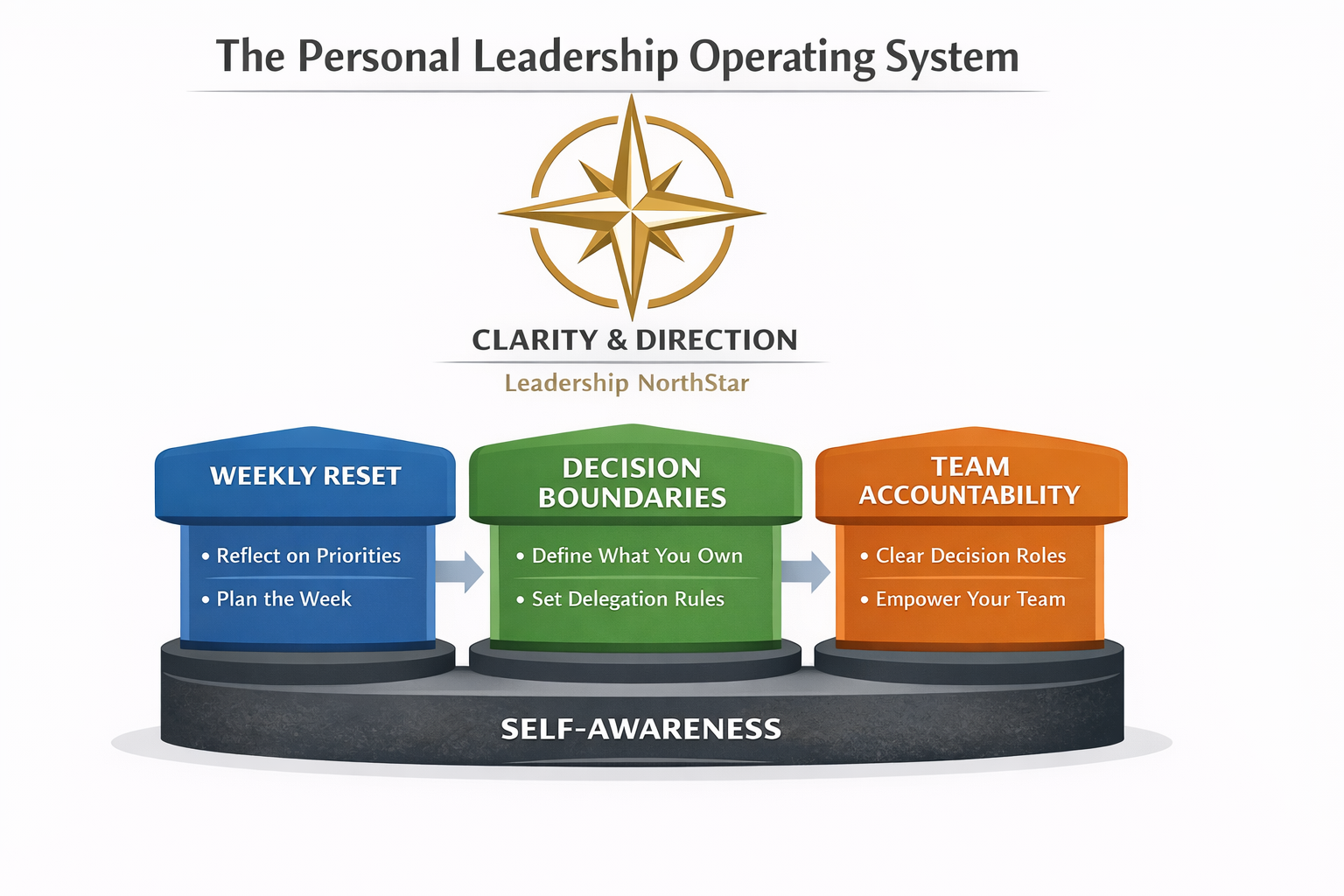
2. Your Operating System Is How You Make Decisions
Your operating system is not your calendar or your task list.
It is how you:
Prioritize what matters
Decide what gets your attention
Determine what only you can do
A simple example is using a prioritization structure like the Eisenhower Matrix to separate urgency from importance.
When leaders don’t define this system, everything feels important.
And when everything feels important, nothing gets led well.
3. Systems Reduce Decision Fatigue
Leaders make hundreds of decisions each week.
Without structure, each one requires fresh thinking.
That is exhausting.
A personal operating system creates:
Default decision rules
Clear delegation boundaries
Repeatable workflows
For example, defining decision ownership through a structured approach like a decision tree allows leaders to move decisions closer to the team over time.
This reduces bottlenecks and frees the leader to focus on higher-level thinking.
4. Self-Awareness Anchors the System
A system without self-awareness becomes rigid.
This is where tools like a leadership self-assessment come into play. They help leaders identify:
Where they struggle
How they respond under pressure
What patterns repeat
The act of slowing down to reflect on your leadership habits is foundational to building a system that actually fits you.
Your operating system should reflect your leadership reality, not someone else’s model.
Example
A regional sales manager at a mid-sized company was leading a team of 8 account executives.
Revenue targets were increasing.
Pipeline reviews were constant.
And every deal escalation came directly to him.
His days looked like this:
Back-to-back calls
Slack messages nonstop
Jumping into deals late to “save” them
Staying late to catch up on planning
He wasn’t leading the business. He was reacting to it.
What Was Actually Broken
Not effort or skill.
He didn’t have a Personal Leadership Operating System.
Specifically:
No clear prioritization structure
No defined decision ownership
No consistent weekly reflection or reset
So everything came to him.
The Shift
We built a simple operating system:
Weekly Leadership Reset
• Review pipeline by importance, not urgency
• Identify top 3 strategic deals only he would engage in
Decision Boundaries
• Defined what reps could decide without him
• Escalation only for pricing exceptions or legal risk
Deal Review System
• Standard format for reps to present deals
• Reduced random interruptions and incomplete information
The Result (Within 6 Weeks)
Fewer interruptions during the day
Sales reps took more ownership of deals
Pipeline conversations became more strategic
He regained time for forecasting and coaching
Most importantly: He stopped being the bottleneck.
Leadership Application
If you want to begin building your Personal Leadership Operating System, start here:
One Actionable Step: Create a Weekly Leadership Reset
Set aside 30 minutes each week and ask:
What actually mattered this week?
What decisions only I should be making?
What can I delegate next week?
What created unnecessary stress?
Write it down. Review it weekly.
This becomes the foundation of your operating system.
Simple. Repeatable. Grounded.
Closing Reflection
Leadership is not built on effort alone. It is built on structure that supports good decisions.
Your Personal Leadership Operating System is what allows you to lead consistently, even when things get busy or uncertain.
If you’re feeling stretched, it may not be a capacity issue.
It may be a system issue. And the good news is, systems can be built.
Are you ready to build your Personal Leadership Operating System in a structured, supported way, my Leadership Foundations Mastery Program walks you through it step by step.
Or, if you prefer to start small, contact me for access to the templates and tools inside my Curated Resources Hub.
If you’d like, we can explore what your current system looks like and where to strengthen it.
Book a Leadership Breakthrough Call 👉Here