
See Our Latest Blogs
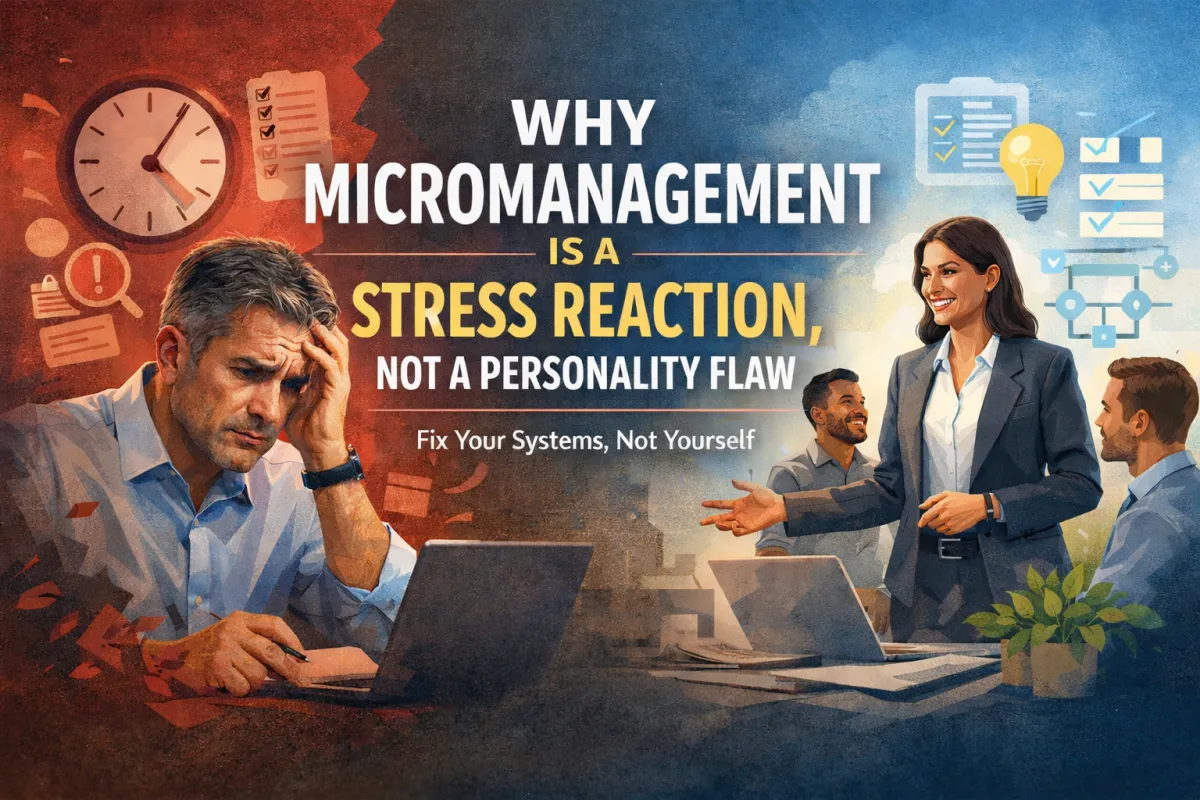
WHY MICROMANAGEMENT IS A STRESS REACTION, NOT A PERSONALITY FLAW
Micromanagement isn’t who you are. It’s what happens when stress outruns your systems.
Key Takeaway:If you want to be a better leader this year, stop trying to “fix” your personality and start building systems that reduce stress, clarify expectations, and create trust. Micromanagement fades when pressure does.
January Is Full of Good Intentions
Every January, leaders tell me some version of this:
“This year, I’m going to be a better leader.”
“I need to stop micromanaging.”
“I want to trust my team more.”
Those are good intentions and sound great as New Year’s Resolutions. But they’re also vague ones. Roughly 80% of New Year’s resolutions fail by February, not because people don’t care, but because resolutions rely on willpower instead of structure. When stress shows up, old habits win.
Leadership change is no different.
If you don’t turn your resolution into a project or program with systems, stress will pull you right back into the behaviors you’re trying to escape.
Micromanagement Isn’t a Character Issue
One of the most damaging leadership myths is that micromanagers are just “that way.”
They’re not.
Micromanagement is most often a stress response. When pressure rises, leaders instinctively pull control closer. Decisions get centralized. Trust shrinks. Oversight increases.
This shows up clearly in first-time managers and even in experienced leaders under sustained pressure.
This isn’t moral failure. It’s human behavior under load.
Why Stress Triggers Control
Stress narrows thinking. It shortens time horizons. It pushes leaders into survival mode.
When leaders don’t have: Clear decision boundaries, Defined ownership, Trusted systems for visibilitythey substitute presence for clarity and control for trust.
That’s when leaders start checking every detail, redoing work, and inserting themselves everywhere.
Not because they want to.
Because their system can’t support them.
Why Resolutions Fail Leaders
Most leadership resolutions fail for the same reasons personal ones do:
1. They’re identity-based, not system-based
“I’ll trust my team more” isn’t actionable without structures that support trust.
2. They ignore stress triggers
Leaders don’t plan for busy seasons, emergencies, or ambiguity.
3. They lack feedback loops
Without reflection and review, leaders can’t see progress or drift.
This connects directly to my ongoing work on organizational systems:
Organizational Systems → “Systems reduce chaos.”
Decisioning & Delegation → Shared values, independent execution.
Turn Your Resolution Into a Leadership Project
If “stop micromanaging” is your 2025 resolution, here’s how to turn it into a real project.
Name the Stress, Not the Behavior
Ask:
When do I start hovering?
What uncertainty am I trying to reduce?
What decision am I afraid will go wrong?
This aligns with: My focus on using a Self-Assessment → asking what it will take to do a thing, and whether you want to do it.
Build Decision Clarity
Micromanagement thrives where decision rights are unclear.
Create explicit answers to:
What decisions belong to me?
What decisions belong to my team?
What decisions require consultation?
This ties directly to my Decision Tree Template → “Over time, move more decisions to leaf level.”
Replace Surveillance With Visibility
Leaders micromanage when they lack reliable visibility.
Replace:
Constant check-ins
with
Clear outcomes, timelines, and review points
This echoes my focus on Track, Measure, Report → Clarity before action.
Install Reflection, Not Guilt
Micromanagement doesn’t disappear overnight. It fades as systems mature.
Use simple reflection:
Where did I step in unnecessarily this week?
Where did I create clarity instead of control?
This mirrors my Recalibration Template → Re-anchor, Rebuild, Reignite.
Better Leadership Is Built, Not Promised
If this year you want to be a better leader, don’t rely on a resolution.
Join my Leadership Foundations Mastery Program (Praxis Framework™)
Install systems.
Reduce stress.
Create clarity.
Micromanagement isn’t who you are.
It’s what happens when your leadership system is overloaded.
If you’re ready, we can explore how to turn this into a personalized practical leadership program together.
Book an Introduction Call👉Jeff Hill Consulting 15m Introduction
Need some templates to start your system? Go to myEtsy Store or contact me for details to access my Curated Resources Hub.