
See Our Latest Blogs
Week 10: Strategy Is Not a Goal List
A leader without decision criteria eventually becomes a reaction manager.
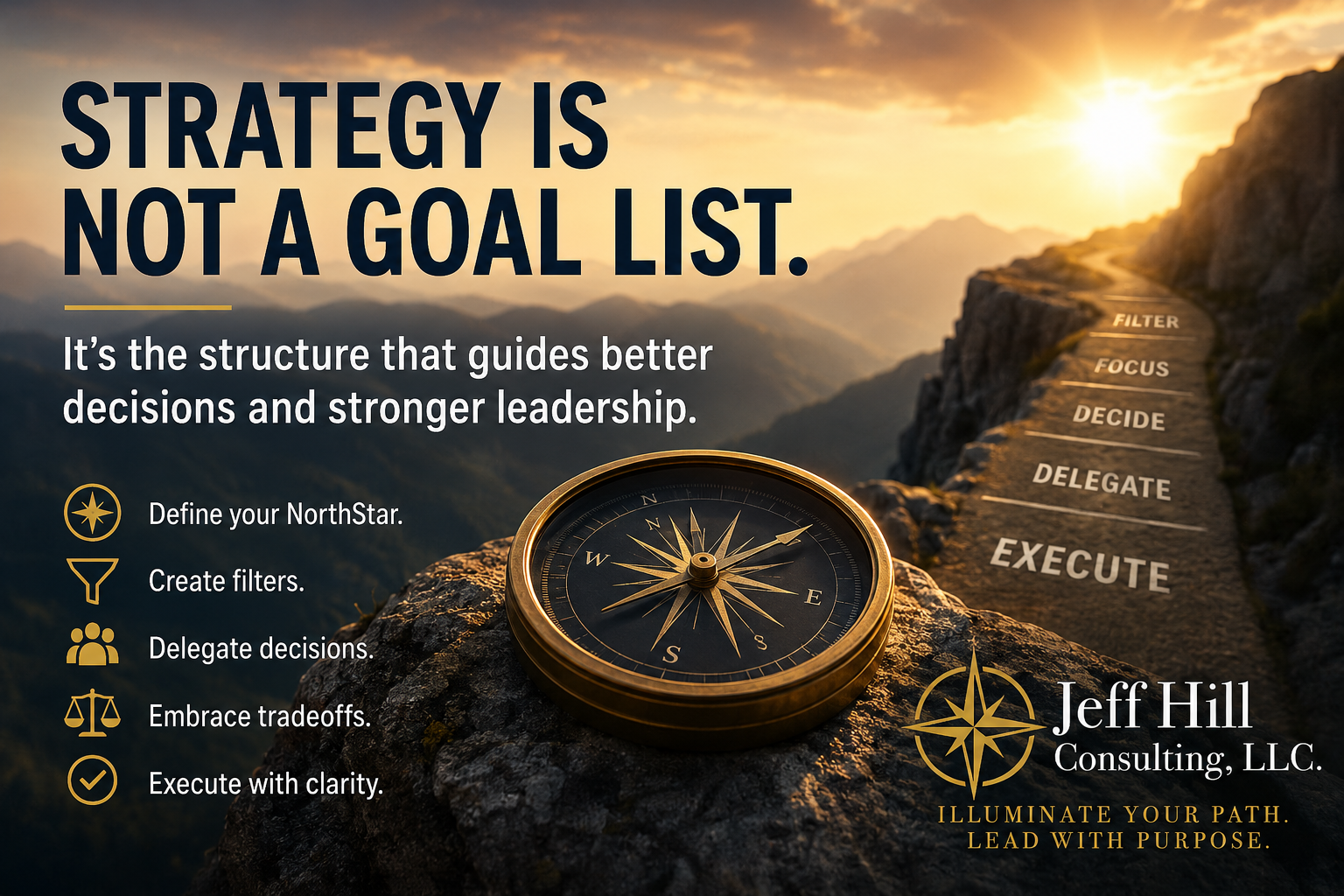
Key Takeaway:Strategy is not a list of things you hope to accomplish. Strategy is the structure that helps you decide what deserves attention, what does not, and what your team should consistently prioritize.
Introduction
Many leaders believe they are being strategic because they have goals. Increase revenue. Improve culture. Hire faster. Launch new initiatives. Reduce costs.
None of those are strategy by themselves.
Goals are destinations. Strategy is the decision-making path that determines how you move toward them.
Without that path, leadership becomes reactive. Teams chase urgency. Priorities shift weekly. Meetings multiply. People work hard and still feel unclear about what matters most.
A strong strategy reduces friction because it gives leaders a repeatable way to make decisions under pressure.
That clarity matters far more than having an impressive list of ambitions.
Strategy Creates Filters
One of the biggest leadership mistakes is treating every good idea as equally important. When that happens:
Teams become overloaded with competing initiatives
Energy gets divided across too many priorities
Leaders unintentionally create confusion because nothing has a clear hierarchy
Good strategy creates filters. Those filters help leaders answer questions like:
Does this align with our NorthStar?
Does this solve a real challenge or just create activity?
What tradeoff are we accepting if we pursue this?
Who actually owns this decision?
My JHC Strategic Planning Framework℠ process emphasizes defining a clear NorthStar before action planning begins. That matters because teams cannot prioritize effectively without a shared direction.
A NorthStar simplifies decisions. It helps prevent organizations from constantly restarting every time pressure changes.
Strategy Reduces Leadership Fatigue
Many leadership problems are actually decision problems.
When leaders lack a consistent decision structure, every issue feels equally urgent. Cognitive load increases. Teams escalate more decisions upward. Leaders become bottlenecks without realizing it.
Over time, this creates exhaustion that people often mislabel as burnout.
The issue is frequently structural, not personal.
My Praxis Framework℠ reinforces this idea through PraxisSpace℠, which focuses on reducing friction, minimizing decision fatigue, and creating operational clarity.
Leaders do not need more willpower to solve this problem. They need clearer systems.
A healthy strategy should make daily decisions easier, not harder.
Strategy Requires Delegation Structures
Many organizations say they want empowered teams, but their decision systems communicate the opposite. If every meaningful decision flows back to one person, strategy eventually collapses under scale.
Delegation is not simply handing off tasks. It is designing clarity around decision ownership.
My JHC Decisioning and Delegation Program℠ illustrates this by encouraging leaders to move more decisions outward over time instead of centralizing everything at the top.
That shift changes the organization in important ways.
Teams begin operating with confidence instead of waiting for permission. Leaders recover time for strategic thinking. Communication becomes cleaner because decision lanes are more defined.
This is one reason strong organizations appear calmer under pressure.
Their decision structure already exists before the pressure arrives.
Strategy Is Proven Through Tradeoffs
A real strategy always excludes something. This is where many leadership teams struggle. They want focus without saying no.
But strategy requires tradeoffs. If everything remains a priority, then nothing has actually been prioritized.
Leaders often avoid these decisions because they fear disappointing stakeholders or missing opportunities. Yet avoiding tradeoffs usually creates larger operational problems later. The result becomes fragmented attention:
Projects stall halfway
Teams lose momentum
Accountability weakens because priorities constantly shift
Strong leaders understand that clarity is often more valuable than optionality.
A smaller number of aligned actions executed consistently will outperform an overloaded organization chasing fifteen priorities at once.
Practical Example
A regional organization entered a growth phase after several successful quarters. Leadership announced five major initiatives within two months:
New software implementation
Expanded recruiting efforts
Internal culture redesign
Reporting changes
Customer experience improvements
None of the initiatives were inherently bad. The problem was that no decision framework existed to rank them.
Managers began competing for time and resources. Team meetings doubled. Employees received conflicting priorities from different departments. Small operational problems started escalating because nobody knew which initiative carried the highest importance.
The leadership team eventually paused all active projects for one week.
During that week, they clarified three things:
Their organizational NorthStar
The top two operational challenges affecting performance
Which leaders owned which categories of decisions
They also used a prioritization system similar to the Eisenhower Matrix to separate urgent operational noise from long-term strategic work.
Within a month, meeting volume dropped. Project completion improved. Team communication became more consistent because priorities stopped changing every few days.
The organization did not succeed because people suddenly worked harder. They succeeded because leadership reduced ambiguity.
Leadership Application
This week, review every major initiative currently competing for your attention.
Then ask:
Which of these directly supports our NorthStar?
Which initiatives are truly strategic versus simply important?
Where are decisions becoming trapped at the top?
What decision criteria have we never clearly defined?
Choose one area where your team lacks decision clarity.
Then build a simple structure around it:
Define ownership
Clarify escalation paths
Identify decision criteria
Remove unnecessary approvals
Do not aim for perfection. Aim for clearer flow.
Small systems improvements often create disproportionate leadership relief.
Closing Reflection
Strategy is not measured by how many goals appear on a planning document.
It is measured by whether your organization can make clear, repeatable decisions when conditions become difficult.
Leaders who understand this stop treating strategy like aspiration.
They start treating it like architecture.
And architecture changes how people work every day.
If you are realizing your organization has goals but lacks a true decision structure, the Organizational Systems Program may help you create clearer workflows, delegation systems, and leadership alignment.
If you’re ready, we can explore this together through my Praxis Framework℠ and the Leadership Foundations Mastery Program.
Click here to schedule a call 👉Schedule 30min Introduction