
See Our Latest Blogs
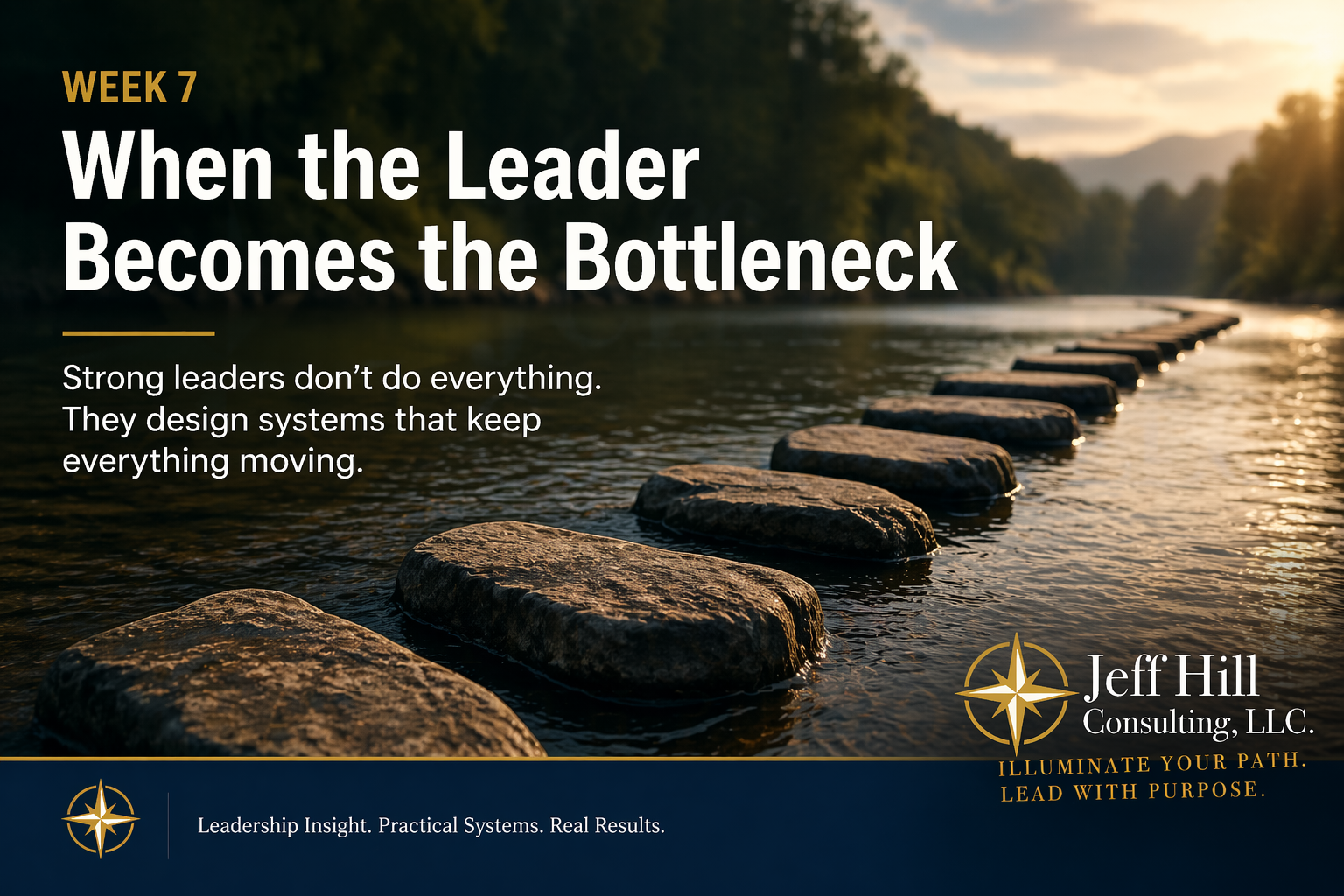
Week 7: When the Leader Becomes the Bottleneck
A leader’s role is not to carry the work, but to create the conditions where the work moves.
Key Takeaway:If progress slows because everything runs through you, the issue is not effort. It is a system that hasn’t been designed to operate beyond the leader.
Introduction
There’s a moment many leaders reach that feels confusing. You’re working hard. You’re involved. You’re responsive. Yet things don’t seem to move faster. In fact, they may be slowing down.
Projects wait. Decisions pile up. Your team hesitates more than you expect.
It’s not a lack of capability. It’s a signal.
The system has centered around you.
And when that happens, even strong leadership can unintentionally limit progress.
Main Leadership Insight
1. Bottlenecks Form When Systems Default to the Leader
Most bottlenecks don’t come from control. They come from absence of clarity.
When ownership is unclear, work naturally flows upward. People look for direction, confirmation, or approval.
Over time, the leader becomes the default path for movement. This is not about intention. It’s about design.
If the system does not define how work moves, it will always move toward the person with the most authority.
2. Decision Flow Determines Team Speed
The speed of a team is directly tied to how decisions are made.
If decisions pause until they reach you, the team’s pace becomes your pace. Not your team’s capability.
Not the urgency of the work. Just your availability.
Strong leaders design decision flow so that most decisions are handled at the level closest to the work. This creates momentum without sacrificing alignment.
3. Involvement Can Create Dependency
Leaders often stay involved because they care about outcomes. They review work. They answer questions. Not only that, but they step in to keep things moving.
But over time, consistent involvement can shift behavior.
Instead of building solutions, the team brings questions. Instead of moving forward, they wait for confirmation.
Dependency rarely feels obvious in the moment. It builds gradually through repeated patterns.
And once dependency forms, it slows everything down.
4. Clarity Reduces the Need for Oversight
Oversight is frequently a substitute for clarity. When expectations, roles, and decision boundaries are not defined, leaders compensate by staying close to the work.
But when clarity exists, oversight naturally decreases.
Clear expectations create consistency.
Clear ownership creates accountability.
Clear boundaries create confidence.
Clarity is how leaders move from being involved in everything to being effective where it matters most.
5. Leadership Shifts from Doing to Designing
Early in leadership, value often comes from doing. Solving problems. Making decisions. Driving outcomes directly.
As leadership grows, that approach stops scaling.
The shift is subtle but important.
Leadership becomes less about executing work and more about designing how work gets executed. This includes how decisions are made, how priorities are set, and how accountability is maintained.
When that design is strong, the team moves without needing constant direction.
Practical Example
A leader overseeing a growing team noticed that timelines were slipping.
Work was getting started, but progress would stall midway. Team members would pause, waiting for feedback or approval before continuing.
The leader responded by becoming more available. More check-ins. Faster replies. More involvement in day-to-day decisions.
It helped briefly.
Then the same pattern returned.
When we looked closer, the issue became clear. The team did not have defined decision boundaries. They weren’t unsure of what to do. They were unsure of what they were allowed to decide.
We worked together to define three simple categories:
Decisions the team could make independently
Decisions that required consultation
Decisions that required escalation
Within weeks, the pauses started to disappear. The leader was still engaged, but no longer required for every step.
Progress improved because the system allowed it to.
Leadership Application
Here is one step you can take this week:
Identify where work is waiting on you. Look at your current projects or tasks and ask:
Where are things paused until I respond?
What decisions am I repeatedly being asked to make?
What guidance could remove that dependency?
Then choose one area and define:
Who owns the decision
What “good” looks like
When to involve you
Keep it simple. The goal is not perfection. It is movement.
If you want to go deeper, tools like my Leadership Self-Assessment Survey can help you surface patterns in how your leadership shows up day to day.
Closing Reflection
Becoming the bottleneck is not a sign of failure. It is often a sign that your leadership has outgrown your current system.
The instinct is to do more. But growth requires something different.
It requires designing how leadership flows through the team, not just from the leader. When that shift happens, everything begins to move with more clarity and less friction.
If you’re ready, we can explore how to build that together.
If this feels familiar, it may be time to strengthen the systems around your leadership. My Organizational Systems Program is designed to help you define decision flow, clarify ownership, and build structures that allow your team to operate with confidence.
Or, if you prefer to start smaller, my Curated Resources Hub has practical tools to begin organizing your leadership approach right away.
Either path moves you toward the same outcome:
A team that moves forward without waiting.
Reach out now for a brief introduction 👉30min Introduction